
AI training in general is geared towards improving the quality and performance of AI models. One area that is of particular importance is the technical advancement of AI models.
This is why AI training companies are in need of experienced developers who can assess the performance of AI models in the aspect of coding. Their responsibilities usually include evaluating AI-generated solutions by spotting subtle bugs, building and improving AI-generated code.
Software engineers and technical experts typically grade these code outputs from AI and, in some cases, write code that serves correctional purposes.
2. Types of AI Training Jobs for Software Engineers
AI Coding Trainer / Code Evaluator
General AI trainer or code evaluator is one of the sought-after roles. Many people mistake this position to be entry-level, since you will barely ever get to write a line of code.
This is actually far from the truth because AI companies need engineers with years of experience to be able to rightly pass judgement on an AI output.
Code evaluators usually review AI-generated code, identify bugs and verify whether the AI output aligns with the prompt requirements.
Coding RLHF and Preference Ranking
RLHF experts are usually tasked with the responsibility of comparing two or more model answers and deciding which is better, and explaining the decision through structured feedback.
This typically translates to ranking AI code responses to ascertain the better option in order for the models to understand how to improve.
Source: AITraining.jobs – Coding & Software Evaluation
Code Review and Bug Hunting
Code reviewers and bug hunters usually get paid high to review AI-written solutions for correctness and quality.
Unlike regular evaluators, they scrape for bugs in the AI response so the AI can consistently produce high-quality code.
AI Red Teaming / Adversarial Testing
Red teaming in AI is a preventive process where experts work to strengthen the safety protocols and guardrails of AI models by testing to break or trick them.
Software engineers working as red teamers create engineering prompts that probe model reasoning, test incomplete requirements, architectural tradeoffs, conflicting constraints, and multi-step engineering workflows.
Agent Evaluation
These sets of AI trainers check the overall performance of agentic models, from prompt-response alignment to the safety and performance of the agent.
3. How Much Do AI Training Jobs for Software Engineers Pay?
The more advanced AI models get, the more the reduced need for generalists becomes clear. In the same vein, the need for technical experts becomes highlighted.
Software engineers are amongst the most sought-after professionals for AI training currently. This high demand also translates to high pay.
Mindrift claims to pay coding experts $32–$90+ per hour, depending on role and experience.
AITraining.jobs reported a broader coding-evaluation range of $25–$200+/hour, while specialized engineering experts can earn $120–$200/hour.
Sources: Mindrift – AI Coding Projects | AITraining.jobs – Coding & Software Evaluation
Check out ExpertWoka's complete breakdown of how much AI trainers make in 2026.
4. What Programming Languages Are Most in Demand?
While, from time to time, AI training has been conducted on every programming language, there appears to be a demand for Python engineers.
A lot of AI companies frequently advertise vacancies for people with substantial knowledge of Python.
Some other languages that are in high demand include TypeScript/JavaScript, Rust, C++, Go and Java.
5. What Skills Do You Need for Software Engineering AI Training Jobs?
Most AI training jobs, as base requirements, ask for trainers to have attention to detail, be able to communicate in English and be interested in AI training roles.
In addition to these general skills, software engineers who are favoured for AI training must have professional fluency in at least one mainstream programming language and the ability to clearly explain why one solution is better than another, which ties back to communicating clearly in English.
These requirements change according to the complexity of the role and specificity of the language. Some roles may require the ability to debug and added requirements like good knowledge of data structures and algorithms.
Apart from having these skills, the years of experience matter a lot. Software engineers with over 5 years of experience will generally be preferred over another with 2 years, unless in rare cases when the latter outperforms the former in the onboarding assessments and interviews.
6. Do You Need AI or Machine Learning Experience?
AI companies usually clarify that their main interest is your expertise in the particular language or languages required in the project.
Machine learning experience is not a compulsory requirement.
Alignerr adds that familiarity with AI/ML concepts, LLMs, or prompt engineering appears under “Nice to Have,” rather than the core requirements.
Source: Alignerr – Software Engineer (AI Training)
So, if you are wondering whether you are qualified, or you are doubting your eligibility because of your little or no experience in AI/ML, you can stop doubting and go for it if you have proficiency in the programming language of interest.
7. Are AI Training Jobs Open to Junior Developers and Senior Software Engineers/Technical Experts?
The more AI develops, the more the requirements of trainers become demanding.
In the earliest stages of AI training, when AI trainers still compared two responses to determine which was better and many generalist roles were trending, junior devs could do some foundational tasks in the easy category.
Mindrift currently states that junior developers without strong code-review experience are probably not a strong fit for its AI code-review work.
This is because AI needs the best of the best to help it improve, and a junior dev might not cut it.
There are a few junior dev AI training roles from time to time, but they are increasingly getting smaller as AI improves.
Senior developers with 5+ years of professional experience appear to be the industry standard when it comes to code review and QA projects.
Of recent, there has been increasing demand for STEM developers with mathematics, physics, engineering or data science backgrounds, and to crown this, they are demanded to have proficiency in Python.
Some roles demand working knowledge in over 3 programming languages. All these block junior devs' eligibility for these projects.
8. Best AI Training Companies and Platforms for Software Engineers to Find AI Training Jobs
Before I list my top pick, I want to say that Turing deserves the number one spot because it has been a leading company pairing software engineers with Fortune 500 companies even before the spread of AI training.
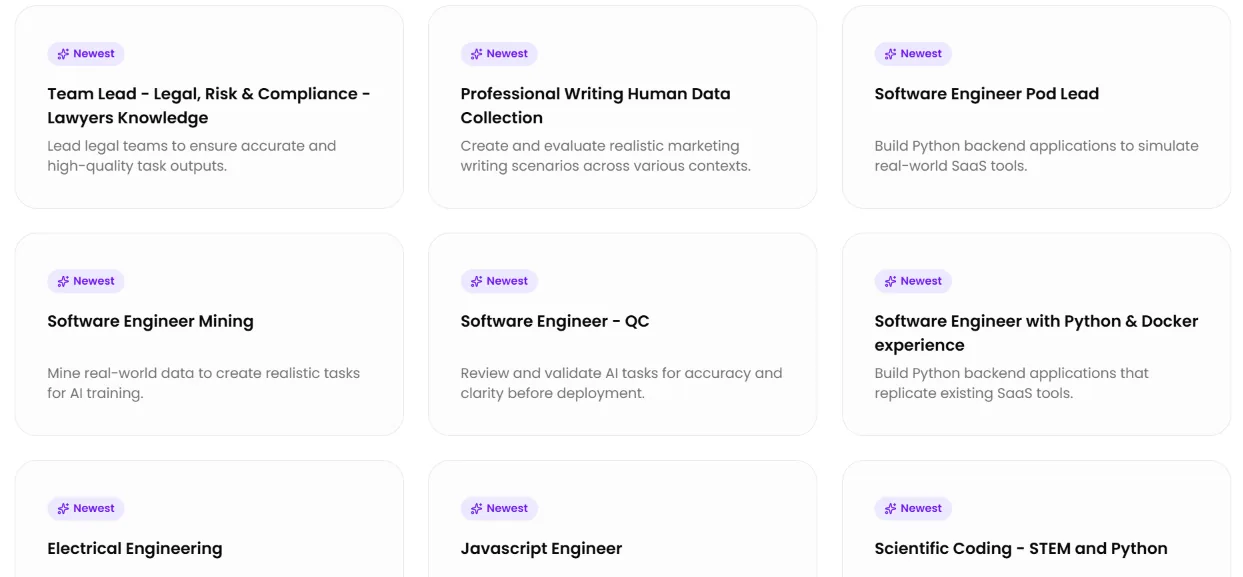
These pay rates in the list are just estimates and should be treated as such.
Also, apart from putting Turing on top due to its long-lasting excellence, the list is not made in any particular order. This is because, while some companies will pay more, they may be lacking in tasks in comparison to others.
Turing: $35–$100+/hr
micro1: $40–$200/hr
SuperAnnotate: up to $35–$65/hr
Mercor: $70–$250/hr
AfterQuery: $25–$50/hr
Alignerr: $70–$120/hr
OpenTrain AI: $50–$100+/hr
xAI: $60–$100/hr
Handshake AI: $125/hr
Outlier: $30–$60/hr
Mindrift: $30–$60/hr
Surge AI: $70–$200/hr
DataAnnotation: $50–$100+/hr
Stellar AI: $25–$60/hr
DataAnnotation is one example of a platform offering paid coding work where contributors evaluate AI-generated responses and work on coding-related projects.
Source: DataAnnotation
Each of these platforms usually has its unique onboarding process, but in general, they fall under test, interview or both.
The tests are usually technical and similar to what the actual project looks like.
To get hired, you must check these websites from time to time or visit the opportunity section of ExpertWoka, as we curate new software engineering positions for AI trainers.
Apart from timely application, you must ensure your CV and portfolio are up to date. Recruiters check these to ensure they select the best candidate for the job.
Applying across multiple platforms is the smart strategy because work arrives in waves and an individual platform can become quiet at times.
9. Are AI Training Jobs Worth It for Software Engineers?
So, I will let you decide on this one.
I have listed the pros and cons so you can make the ultimate decision whether to participate in AI training projects or not.
Pros
High hourly rates.
Merit-based entry on some platforms.
Flexible/asynchronous work.
Frequent payments on some platforms.
Exposure to AI-generated code and model reasoning.
Cons
Project availability can be inconsistent.
Effective earnings can be lower than advertised rates because of calibration, instruction reading and downtime.
No traditional employment benefits.
Quality scores can affect task availability.
Work can become repetitive.
If, after going through the pros and cons, you decide to participate in AI training projects, one personalized piece of advice I will give you is to focus on providing quality data in these projects.
Promotions usually go to experts who show superior judgement quality. Clear communication in the expert channels and attending meetings help to position you as an active expert who can also get recommended for promotion amongst the team.