An AI trainer simply helps improve the performance of an AI model or how it interacts with a product that utilizes AI. Thus, AI trainers work on an ample array of tasks due to the versatility of the use cases of AI today.
Typically, projects that are made to directly train an AI model usually include AI response evaluation, data annotation, prompt writing, AI language training, domain experts, coding, fact-checking, and more.
Projects that are meant to improve the performance of an AI model on a tool or business can have more niche requirements, like verifying if some selections within a category are appropriate, improving recommendation systems, and more.
Of recent, AI labs have been interested in advancing the reasoning and depth of their models, and this has birthed many projects that target improving the chain of thought, factuality, and thoroughness of AI.
Many AI training companies like Mindrift, Mercor, Turing, Handshake, etc., have several versions of these projects with different names. Usually, these types of projects are more demanding and equally pay more.
2. How Much Do AI Trainers Make in 2026?
To find one single amount and agree on it as the average AI trainers make would prove a little difficult. This is because AI trainers' payments vary due to many reasons, ranging from the difficulty level of the task, the location of the AI trainer, the location of the client, the nature of the contract, the qualification of the AI trainer, and more.
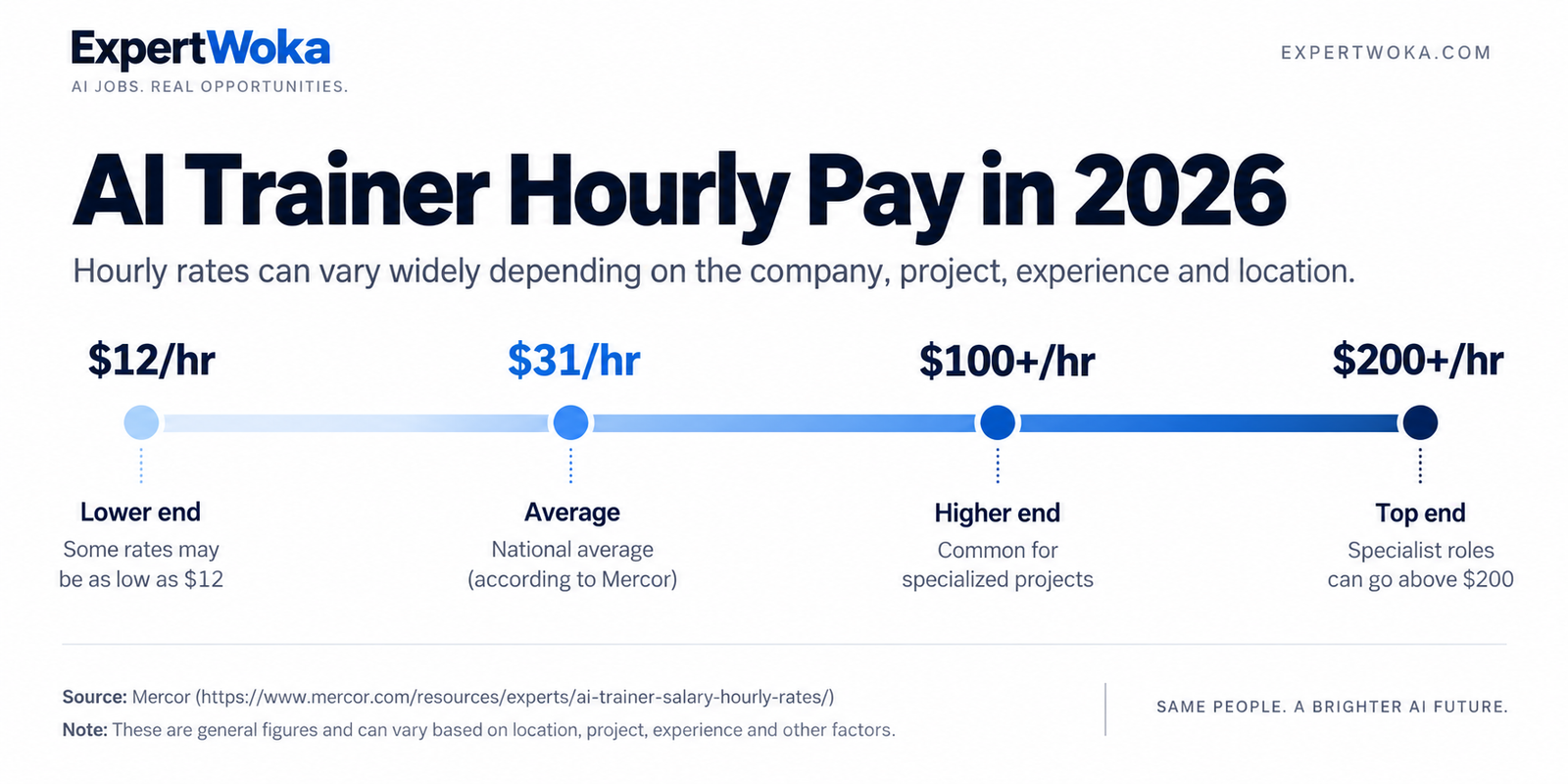
Despite this difficulty in arriving at a single correct figure, Mercor claims the national average AI trainer pay per hour is $31, as of early 2026. Mercor also admits that some rates may be as low as $12 and can go above $200 per hour.
Mercor, on average, pays AI trainers about $31 an hour, with hourly rates ranging from $12 to $200+.
As someone who has worked with over 10 different AI training companies and participated in countless projects, the highest I have been paid per hour was on a Pareto project that paid $30 per hour. This was a generalist project and required no specialization.
Usually, projects in STEM, legal domains, finance, and medicine pay way better.
Since I have mentioned the highest I have been paid, I think it is worth mentioning the lowest I have made per hour (smile). The lowest I made per hour was from an Atlas Capture project that paid me $2 per hour.
That was terrible pay but equally a low-hanging fruit, so I did it during the period I couldn’t find better projects.
Let's go back to finding if we can agree on an average pay lol.
ZipRecruiter, as of Sep 8, 2026, claims that the average annual pay for an AI Trainer in the United States is $64,984 a year; that is approximately $31.24 an hour. This is the equivalent of $1,249/week or $5,415/month.
Again, this is the best-case scenario. AI trainers in many lower-income countries earn significantly less due to geographical arbitrage and fewer available tasks.
3. AI Trainer Pay by Experience Level
If we attempt to isolate experience in and of itself, I would estimate the average entry payment to be around 10 dollars per hour for global workers, and $12–$25 for workers in the USA, Canada, UK, Australia, and a few other higher-paying countries.
Mid-level AI trainers typically earn around 10 dollars above the average rate of entry-level trainers, which puts them around $25–$35 per hour.
Expert and specialized AI trainers in companies like Micro1, Mercor, Surge AI, xAI, and Snorkel can get paid around $75–$200 per hour.
4. AI Trainer Pay by Type of Work
As already established above, the typical pay for AI trainers can range from around $15 to $100+ per hour, depending on the company, project, experience, and location.
The particular project plays a large role in determining the pay.
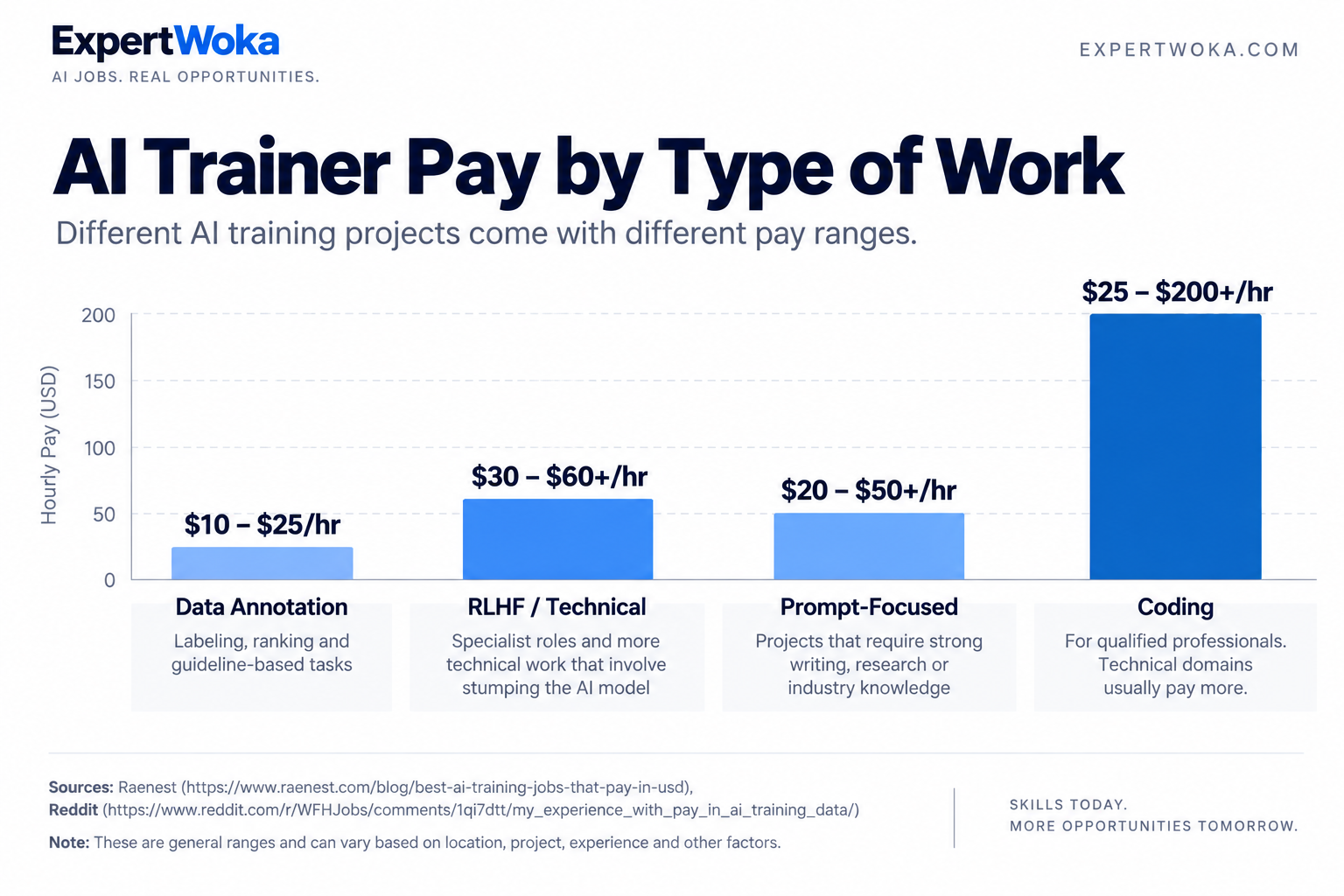
According to Raenest, regular AI data annotation jobs can pay around $10 to $25 per hour, while RLHF specialist roles or more technical roles that involve stumping the AI model pay up to $30 to $60+ per hour.
Some prompt-focused projects pay $20 to $50+ per hour, particularly when they require strong writing, research, or industry knowledge.
Coding AI training jobs can pay $25 to $200+ per hour for qualified professionals. Such technical domains usually pay more.
On Reddit, some Redditors estimated that generalist data annotation (basic labeling, ranking, guideline-based tasks) usually sits on the lower end. In their experience, it’s around $8–$20/hour.
I would say that is still within the range of our observation.
5. How AI Training Companies Pay Workers
Many AI trainer contracts are freelance or independent contractor arrangements. In the United States, some of these may be 1099 contracts. Thus, AI trainers are basically paid hourly or task-based, unlike traditional 9-to-5 jobs.
If you are wondering about the means of payment used by these AI trainer companies, I would rather suggest you search specifically for the AI company you have in mind because it’s a really long list of methods.
Many AI training platforms pay directly to bank accounts, while some, like Micro1 and SuperAnnotate, use Deel. Mindrift uses Payoneer and PayPal for payment.
To be honest, means of payment is becoming less of an issue because of how advanced payment systems are these days. So I wouldn’t bother doing a deep investigation on all the payment systems each AI company uses.
Just make sure the specific AI company you are applying to is using a payment medium you can receive money with.
6. AI Training Platforms and Their Typical Pay Rates
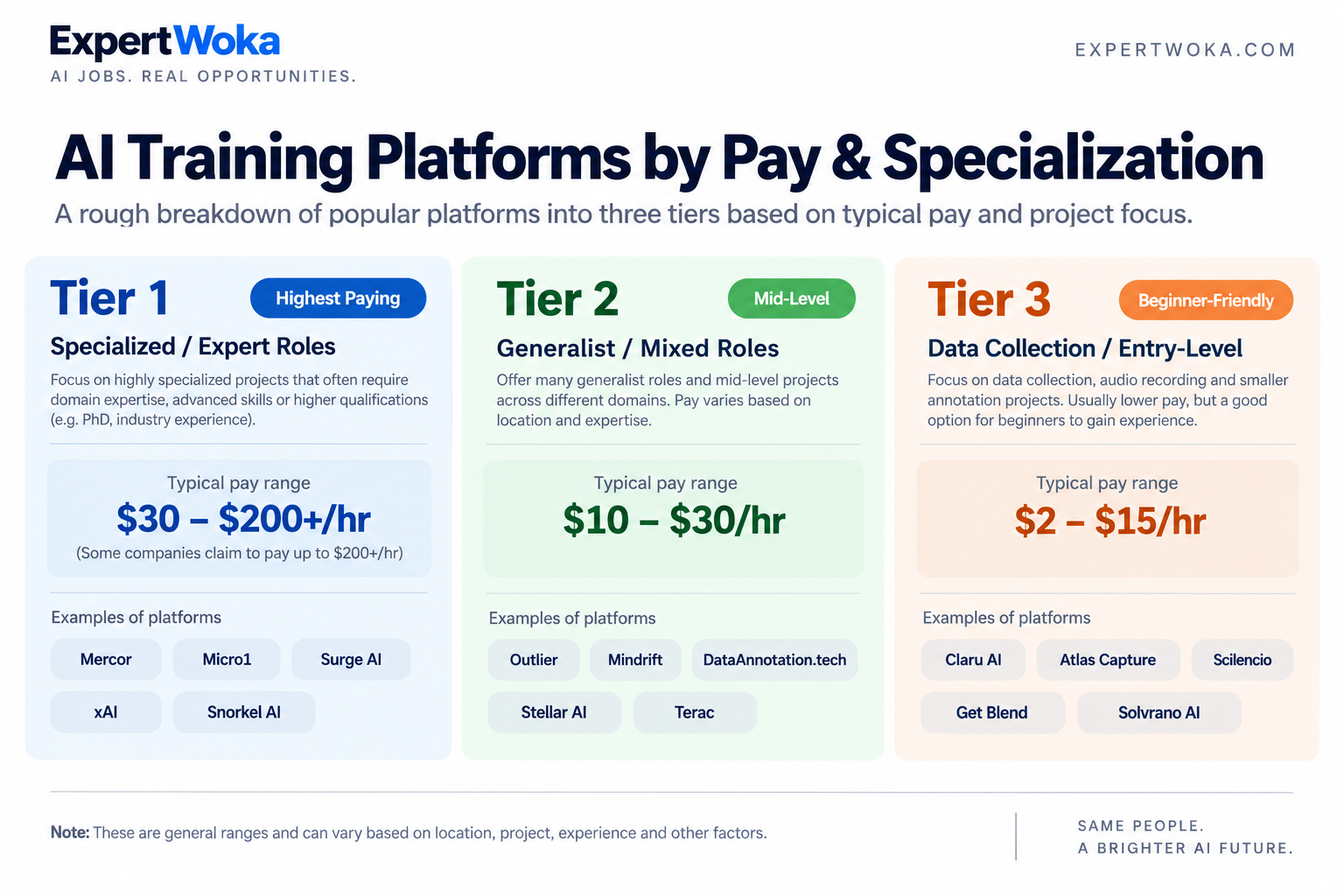
I would like to make a rough division of the AI training platforms into 3 different tiers.
Tier one, being the elite tier, comprises AI training platforms like Mercor, Micro1, Surge AI, xAI, and others that focus on highly specialized projects that involve PhD holders and experts with ample experience.
This tier usually pays very well. It is difficult to generalize because these companies still have generalist and entry-level roles that pay way less than their top tiers do.
But on the high side and factoring in higher-paying countries, I would place the payment scale around 30 to 70 dollars per hour realistically. Companies in this category usually claim to pay up to $200 per hour.
Tier 2 platforms include platforms like Outlier, Mindrift, DataAnnotation.tech, Stellar AI, Terac, and other platforms that have many generalist roles and mid-level requirements.
These platforms typically pay around 10 to 30 dollars per hour for many of their projects. It's still worth noting that location and expertise are key variables.
Tier 3 platforms are usually smaller companies that handle audio recording, data collection, and small annotation projects.
While these companies don’t pay as much, they are usually the best for beginners to try their hands on. Companies like Claru AI, Atlas Capture, Scilencio, Get Blend, and Solvrano AI all fall under this.
7. What Determines How Much You Can Earn as an AI Trainer?
Mercor claims domain expertise and credentials are the biggest lever in increasing your AI trainer salary. While this has some merit to it, I would say the most realistic determinant will be location.
In considering how much you can make as an AI trainer, two metrics prove important:
1. Pay per hour: The amount you are paid per hour will largely determine how much you can possibly make in a week/month. AI trainers in countries with significantly high pay therefore get the advantage.
2. Project availability: AI trainers in higher-paying countries usually have more project availability from different platforms. This simply means that even if two AI trainers earn the same amount per hour, the trainer with more available projects has the potential to earn more overall.
8. Can You Make a Full-Time Income Training AI?
Yes, but the income can be inconsistent.
Mo Zohourian told Business Insider that he works 20–40 hours a week training AI, but projects can sometimes pause for weeks or even a month.
Experiences on Reddit vary widely. One worker reported earning about $10,000 over 18 months and couldn't rely on it as a sole income, while another reported earning $3,000–$10,000 per month consistently.
You can check out the full Reddit discussion here to see what other AI trainers are earning.
9. Where to Find AI Training Jobs in 2026
The best way to find AI training projects is in the career section of AI training platforms, and here are the top platforms you can check out directly or sign up for: Mercor, Micro1, xAI, Turing, Mindrift, Outlier, Handshake AI, Snorkel AI, Terac AI, SME Career, Welocalize, Lionbridge, OneForma, CrowdGen, TELUS, and many more.
It's worth noting that some of these platforms have dedicated communities for their AI trainers that require sign-in to access.
Apart from checking individually on the career pages of these platforms, following them on LinkedIn and other social media also proves helpful, as it keeps you informed and ready to grab any opportunity that becomes available.
Also, many AI training platforms post their vacancies on LinkedIn. So, it is helpful to set your LinkedIn preferences to show you AI training roles so they get suggested.
Aggregation websites like ExpertWoka are also an excellent way to catch any new vacancy since they collate the best vacancies across different platforms and send newsletters when vacancies matching your expertise and location become available.
In conclusion, AI training pays and arguably pays even well, especially if you live in a higher-paying country and have in-demand skills and expertise. However, pay and project availability vary widely, so it is difficult to predict exactly how much any individual AI trainer will make.