
Every time an AI Model gives you a useful answer, recognizes a stop sign, or transcribes a voice note correctly, there's a very good chance a human being sat somewhere and labeled thousands of examples so the model could learn the difference between "correct" and "wrong." That work is called "Data Annotation", and in 2026 it's one of the fastest-growing categories of remote work in the world.
If you've searched for data annotation jobs recently, you've probably noticed two things: demand is exploding, and the information out there is confusing. Some sites make it sound like Annotation is only about drawing boxes around cars in photos. Others lump it together with "AI Training" as if the two terms mean the same thing. Neither is accurate, and neither gives you what you actually need to land legitimate, well-paying work.
This guide breaks down what Data Annotation really involves, the different types of annotation work available, the skills that get you hired, how quality assurance actually works on real projects, what you can expect to earn, and how to tell a real opportunity from a scam.
What Data Annotation Actually Is
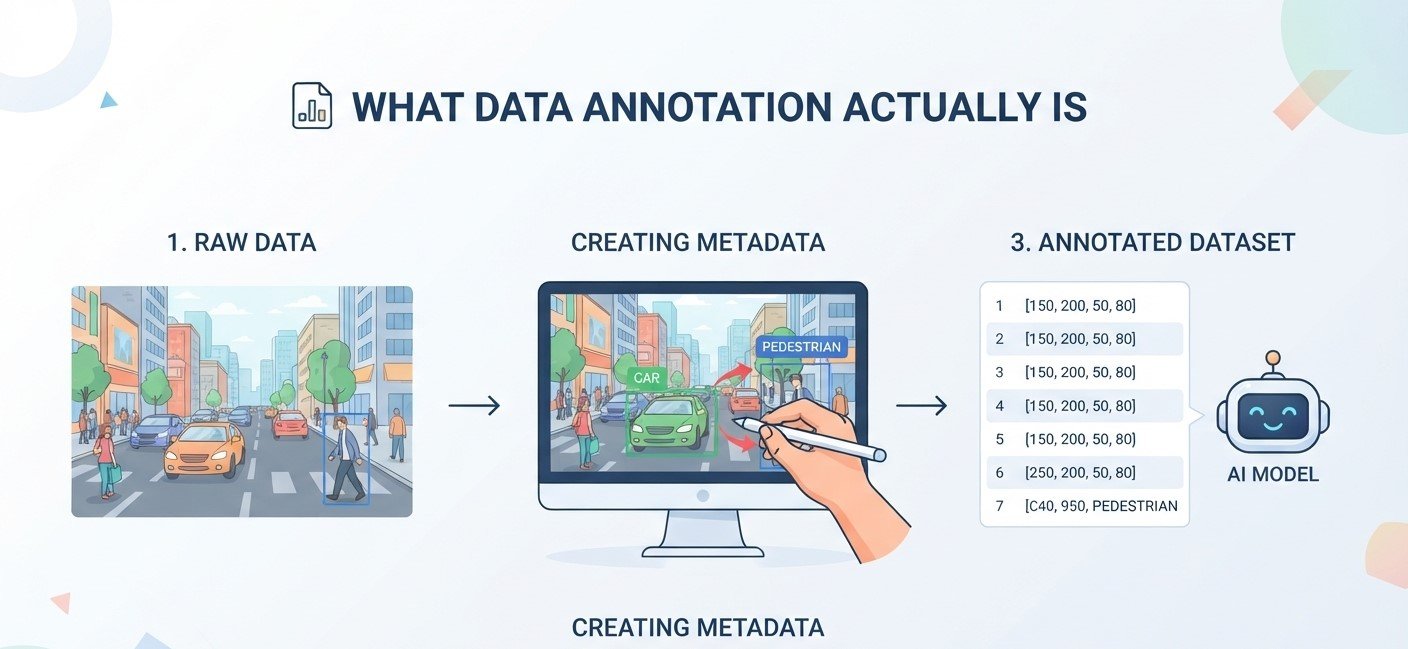
Data Annotation is the process of adding labels, tags, categories, or judgments to raw data so that a machine learning model can learn patterns from it. Raw data which includes a scanned document, a customer service recording, a photo, a paragraph of text means nothing to an algorithm on its own. Annotation is what turns that raw material into structured, machine-readable training examples.
Think of it less like a single task and more like an entire discipline. A model that recommends products needs annotated purchase behavior. A model that answers customer questions needs annotated conversations showing what a good response looks like versus a bad one. A Voice Assistant needs annotated audio showing where words start and end, who's speaking, and what background noise sounds like. In each case, a person made a judgment call, and that judgment became training data.
Why AI Systems Need Labeled and Evaluated Data
Machine learning models don't understand meaning the way humans do, they detect statistical patterns in examples they've been shown. If you want a model to recognize sarcasm, flag hate speech, summarize a legal contract, or hold a natural conversation, it needs thousands or millions of examples where a human has already made that call correctly. Without that grounding, the model is just guessing.
This need doesn't stop once a model is released either. Companies constantly evaluate model outputs against human judgment to catch mistakes, biases, and edge cases the model handles poorly; a process sometimes called model evaluation or human feedback.
Data Annotation vs. AI Training: What's the Difference?
These terms get used interchangeably online, but they aren't the same thing, and understanding the difference helps you know what kind of role you're actually applying for.
AI training is the umbrella term for the entire process of building and improving a machine learning model — collecting data, annotating it, feeding it into the model, testing outputs, fine-tuning based on feedback, and repeating. It includes technical work like model Architecture and Engineering that most remote contributors never touch.
Data Annotation is one specific, human-driven piece of that pipeline: labeling, categorizing, transcribing, or judging data so the model has something accurate to learn from. You'll also see roles labeled "AI Trainer," "Data Labeler," or "Model Evaluator". In practice, these usually describe annotation-adjacent work rather than the engineering side of AI Training. When you see a job titled "AI Trainer," check the actual task description. More often than not, it's annotation, evaluation, or feedback work, not building the model itself.
Knowing this distinction matters when you're job hunting, because it helps you filter out roles that require a Computer Science Degree from the much larger pool of annotation roles that don't.
The Different Types of Data Annotation
Annotation spans far more than images. Here's a realistic picture of the field.
- Text Annotation
Text Annotation is one of the largest and fastest-growing categories, especially with the rise of Large Language Models. Tasks include:
Sentiment and Intent Labeling: Marking whether a piece of text is positive, negative, neutral, or identifying what the writer wants (a complaint, a question, a purchase intent).
Named Entity Recognition: Tagging people, places, organizations, dates, and product names within a passage.
Text Classification: Sorting documents, emails, or reviews into predefined categories.
Response Ranking and Evaluation: Comparing two AI-generated answers and judging which one is more accurate, helpful, or safe.
Prompt-response Writing: Crafting example questions and ideal answers used to fine-tune conversational models.
Content Moderation Labeling: Flagging text for policy violations, spam, or harmful content.
- Image Annotation
This is the category most people picture, but it's more varied than bounding boxes:
- Bounding boxes and polygons for object detection.
- Semantic segmentation labeling every pixel in an image by category.
- Image classification and tagging describing scene content, quality, or attributes.
- Facial and pose landmarking for certain research and safety applications.
- Optical Character Recognition (OCR) review verifying and correcting text extracted from images and scanned documents.
- Video Annotation
Video Annotation builds on image work but adds a time dimension:
Object tracking across frames for autonomous vehicles, sports analytics, and security applications.
Action and event labeling: identifying when a specific behavior or event occurs in a clip.
Scene segmentation: breaking longer footage into labeled segments.
Content and safety review: flagging video content for moderation purposes.
- Audio Annotation
Voice and audio data have their own annotation needs:
– Transcription: Converting spoken audio into accurate written text.
– Speaker diarization: Labeling who is speaking and when in multi-speaker recordings.
– Intent and emotion tagging: Categorizing tone, urgency, or emotional content in calls.
– Sound event labeling: Identifying background noises, music, or specific audio cues.
- Structured and Specialized Data
Beyond the four main formats, Annotators also work with tabular data validation, sensor and LiDAR point-cloud labeling for robotics and autonomous vehicles, and multimodal tasks that combine text, image, and audio together. It is increasingly common as AI systems become more integrated across formats.
Common Tasks You'll Actually Be Doing
Across all these formats, most day-to-day annotation work falls into a handful of task types: classification (sorting into categories), extraction (pulling out specific information), comparison (ranking or choosing between options), transcription (converting one format to another), and evaluation (rating quality against a rubric). Once you understand these five task patterns, almost any new project becomes easy to pick up quickly.
Skills That Get You Hired
You don't need a technical degree for most Data Annotation jobs, but certain skills separate candidates who get repeat work from those who don't:
Reading comprehension and attention to detail: Most rejected annotations come down to misreading instructions, not lack of intelligence.
Consistency: Applying the same standard to the 500th item as you did to the first is key.
Basic digital literacy: Knowledgeable in spreadsheets, browser-based annotation tools, and following structured guidelines.
Domain familiarity: Knowledge of medical terms, legal language, a second language, or a specific industry can open higher-paying specialist projects.
Written English proficiency (or the target language of the project): Precision in language matters even in non-text annotation, since instructions and labels are usually written.
Ability to follow detailed guidelines without shortcuts: Annotation guidelines are often long and specific for good reason; skipping steps shows up in QA scores fast
How Quality Assurance Works on Real Projects
Every legitimate annotation project has a quality assurance layer, because inconsistent labeling makes training data useless. QA typically works through:
Gold-standard testing: A small set of items with known correct answers, mixed into your regular workload to measure your accuracy without you knowing which items are being checked.
Inter-annotator agreement: Comparing how consistently multiple annotators label the same item; low agreement usually means the guidelines need clarifying or an annotator needs retraining.
Spot checks and audits: Reviewers randomly sample completed work and score it against a rubric
Consensus and adjudication: When annotators disagree, a senior reviewer or a majority-vote system decides the final label.
Feedback loops: Annotators typically receive scorecards or corrections so accuracy improves over time rather than being a one-time pass/fail.
Good QA performance is usually what determines whether you get moved onto longer, better-paying projects.
Qualifications: What You Actually Need
Requirements vary by platform and project, but the baseline for most entry-level data annotation jobs is:
- A reliable computer and stable internet connection.
- Strong reading and written communication skills in the project's working language.
- Availability to meet task deadlines (most roles are flexible/asynchronous, some require set hours).
- Passing a project-specific assessment or qualification task.
- Specialist projects — medical annotation, legal document review, coding evaluation, or multilingual work — often require relevant education or professional background, and pay noticeably more as a result.
Compensation Models
Data Annotation jobs are paid in a few common structures:
- Per-task or per-item pay: A fixed rate for each item labeled, common on microtask platforms.
- Hourly pay: Increasingly common for evaluation and feedback work that requires more judgment and time per item.
– Project-based or milestone pay: A set fee for completing a defined batch or dataset.
– Salaried or contract roles: Full-time or part-time positions with recurring monthly pay, typically for experienced annotators or QA leads.
Rates vary widely by task complexity, language, and specialization. Simple classification tasks pay less than domain-expert evaluation work. As a rule, the more judgment, domain knowledge, or language rarity a task requires, the higher the pay ceiling.
How to Find Legitimate Opportunities
The annotation space attracts scams alongside real work, so a few checks go a long way:
Never pay to get hired. Legitimate platforms don't charge application, training, or "starter kit" fees.
Check for a clear application and assessment process. Real projects test your accuracy before paying you, not after you've handed over money.
Look for transparent payment terms; how you're paid, on what schedule, and in what currency should be stated upfront.
Verify the company has a real presence, a working website, reviews, and a track record of paying contributors.
Be cautious of unsolicited job offers via social media DMs promising unusually high pay for minimal work.
One reliable way to skip the guesswork is to work through an established platform that vets projects on your behalf. ExpertWoka currently lists live openings across data annotation and other remote AI training opportunities for people looking to get into this field from anywhere — not just Nigeria, but the UK, US, Canada, Australia, Germany, and beyond.
Data annotation work has moved well past its early reputation as low-effort, low-value clicking. It now sits at the center of how every major AI system gets built, tested, and improved and that means real, sustained demand for people who can read carefully, follow detailed guidelines, and make consistent judgment calls across text, images, video, and audio.
If you're serious about breaking into this space, start by building a track record on one project, protect your accuracy score above everything else, and diversify across a few active roles once you've proven your consistency. The people earning well in data annotation aren't the fastest clickers — they're the most reliable judges.
Ready to start? Browse the current text, video, and data labeling openings on ExpertWoka and apply to the role that matches your skills today.