If you've been scrolling through remote AI job opportunities on social platforms lately, you've probably seen the phrase "no experience needed" attached to some AI training roles that pay anywhere from $15 to $50+ per hour. It sounds almost too good to be true, and that's exactly why it's worth slowing down and understanding what that phrase actually means before you build your job search around it.
Here's what you should know: no previous professional AI-training experience may be required for some opportunities. That is very different from "anyone can get every AI-training job with no skills or qualifications at all".
Some roles are open to complete beginners. Others still expect a degree, a specific language, subject-matter knowledge, or strong writing ability; they just don't require you to have worked in AI before. Confusing the two is how people end up applying to fifty listings, getting rejected from most, and concluding the whole space is a scam.
What "AI training" Actually Means
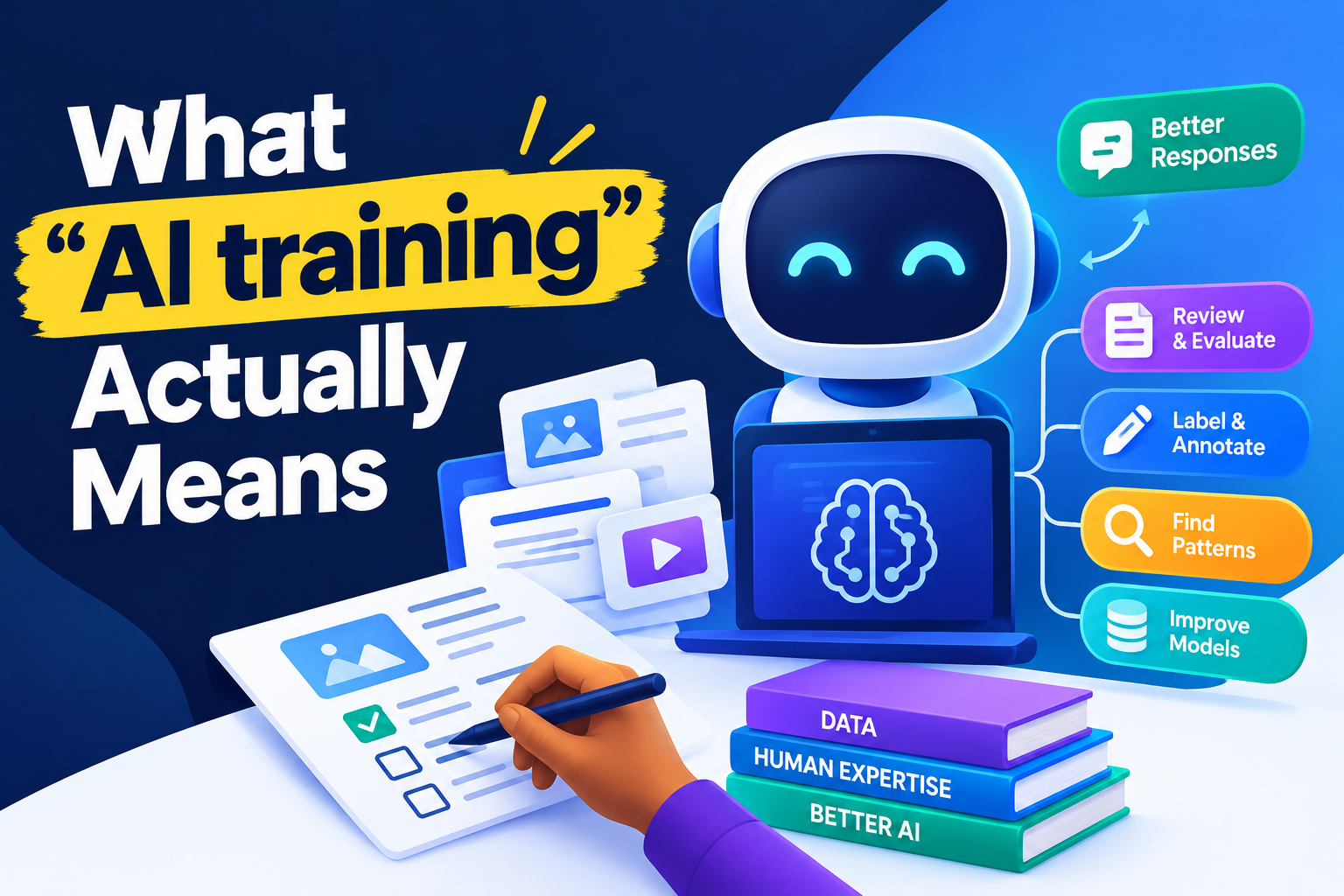
AI training is an umbrella term, and that's part of the confusion. It generally covers the human work that happens behind the scenes to make AI models more accurate, safer, and more useful. In practice, that breaks down into a few distinct task types:
- Data annotation and labeling: Tagging images, marking up text, transcribing audio, or categorizing content so a model can learn patterns from it.
- Model evaluation and comparison: Reading two AI-generated responses to the same prompt and judging which one is better, more accurate, or more helpful, often against a detailed rubric.
- Response writing: Producing sample answers, ideal responses, or reference material that a model is trained to imitate.
- Red-teaming and safety review: Trying to get a model to fail, say something incorrect, or break its own rules, then documenting what happened.
- Content and conversation review: Checking chatbot transcripts for tone, accuracy, or policy violations.
None of this is software engineering. You are not writing code or building the model itself. You're providing the human judgment, language sense, and domain knowledge that the underlying system can't supply on its own. That distinction matters, because it's the reason these jobs can be genuinely open to non-technical people. It is also why "no experience" doesn't mean "no knowledge."
What "no experience required" Actually Looks Like in Real Jobs Postings
It helps to see this in context rather than take it on face view. Pull up any batch of current annotation or evaluation listings and you'll notice a pattern in how companies phrase their requirements.
A recent Micro1 video annotation specialist role posted on ExpertWoka for AI training states plainly that experience working on generalist AI training or evaluation project is a plus, not a prerequisite. While some Data Annotator opportunities could list a Bachelor's Degree or equivalent work experience, native-level English, and basic spreadsheet familiarity as the actual requirements, with previous annotation or content review experience noted separately as something that helps.
Compare that to a Data Annotation Specialist role aimed at Content Moderation and policy work, which explicitly prefers candidates with a background in Media Studies, Communications, Psychology, or Law, plus prior experience in Content Moderation or Annotation. Same broad category of job, very different bar.
The pattern is consistent across the industry: entry-level AI training work typically asks for things like reliable English fluency, a certain education level or equivalent experience, attention to detail, and the ability to follow detailed guidelines consistently. They do not require a résumé full of AI projects. Specialized tracks (legal, medical, coding evaluation, less common languages) raise that bar considerably and often require professional or academic background in the subject. Reading the actual requirements line by line, rather than the headline, is the single most useful habit you can build here.
The Transferable Skills Nobody Tells You That You Already Have
This is where most beginners undersell themselves. You don't need an AI background to be a strong candidate; you need to recognize which of your existing skills map onto this work.
1. Teaching or tutoring experience: it translates almost directly into response evaluation. If you've ever graded essays, corrected student work, or explained why one answer is better than another, you've already practiced the core skill of judging quality against a standard.
2. Customer service and support roles: it build the pattern-following and tone-sensitivity that conversation review work depends on. You've likely already learned to spot when a response is unhelpful, unclear, or off-brand.
3. Writing, editing, and proofreading: are directly valuable for response-writing tasks and for catching errors in AI outputs — grammar, factual accuracy, structure, and clarity.
4. Research and academic work: literature reviews, fact-checking, citation-checking, maps closely onto verifying whether an AI's claims are actually correct.
5. Translation or multilingual fluency: is in high demand, because most AI training work in English is comparatively saturated, while non-English language pairs are chronically short on qualified reviewers.
6. Quality assurance and testing experience from any industry, including manufacturing or software QA, builds the exact mindset annotation guidelines require: follow the rubric precisely, flag edge cases, stay consistent across hundreds of repetitive judgments.
If any of these describe you, you're not starting from zero. You're translating existing skills into a new context, which is a completely different and much stronger position than "I have no relevant background at all."
Beginner-accessible Tasks vs. Tasks That Still Require Credentials
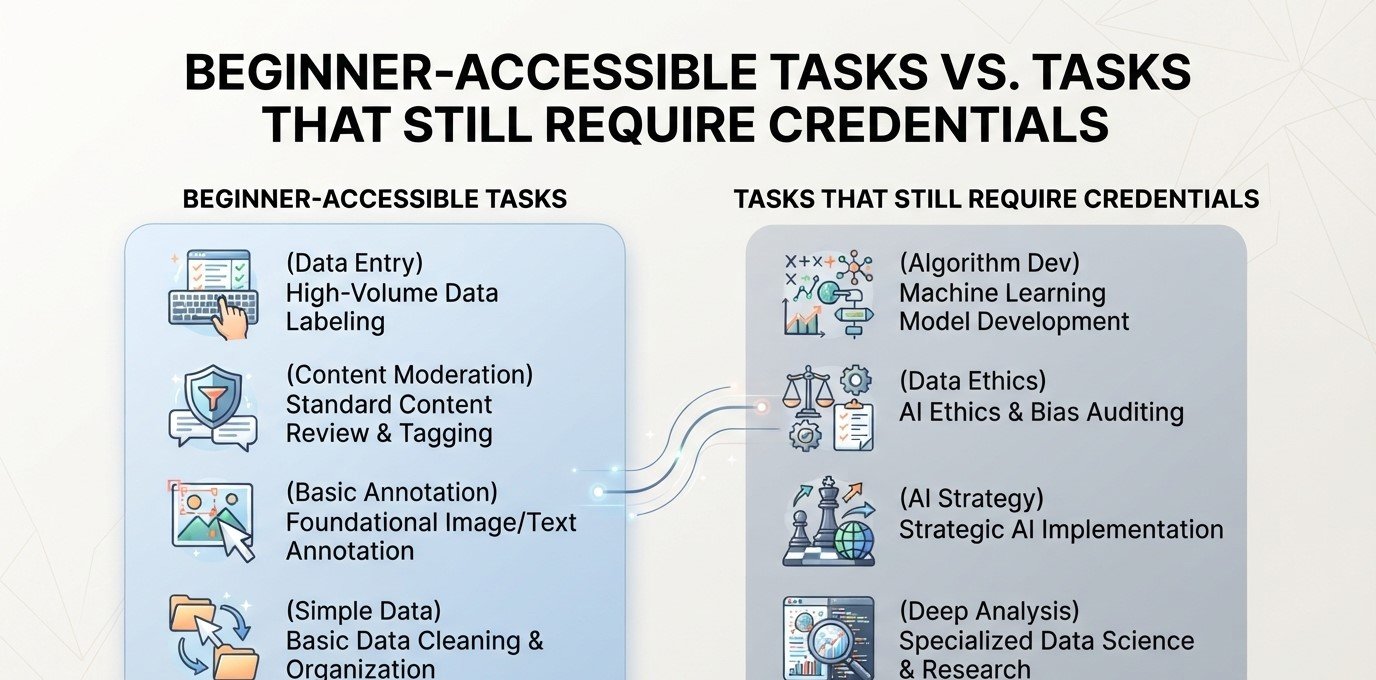
To manage expectations, here's a rough map of where the entry point actually sits:
- Genuinely beginner-accessible (minimal barrier):
- General text annotation and labeling with clear guidelines
- Basic transcription and audio review
- Simple response comparison (which answer is more helpful/accurate)
- Content moderation against defined policy rules
- Image and video labeling for computer vision datasets
- Beginner-friendly but competitive (helps to have some relevant background):
- Conversational AI evaluation, chatbot testing
- General writing and editing tasks for training data
- Search and web-research quality evaluation
- Still requires credentials or specialist background:
- Coding evaluation (needs actual programming ability)
- Medical, legal, or financial domain review (needs the professional qualification)
- Advanced STEM problem evaluation
- Rare-language specialist work (needs genuine fluency, sometimes native-level)
Being clear-eyed about which bucket you're aiming for saves you from wasted applications and from the discouragement of getting rejected from roles that were never designed for beginners in the first place.
How to Build Relevant Experience Before Anyone Pays You For it
You don't need a job to start practicing the actual skill. This is the part most guides skip.
1. Practice on public rubrics. Many platforms publish sample guidelines or example tasks during onboarding or in their help centers. Read through them even before you apply; understanding how a rubric breaks down "helpful," "accurate," and "safe" responses is the core skill, and it's learnable in an afternoon of focused reading.
2. Do it manually on your own. Pick any AI chatbot, ask it the same question twice with slightly different phrasing, and evaluate the two responses yourself as if you were being paid to. Note what you'd flag: factual errors, missed context, tone problems, unclear phrasing. This is literally the task.
3. Volunteer or freelance small annotation-adjacent projects. Transcription, proofreading, translation, or content moderation gigs on general freelance platforms build a visible track record, even in small amounts.
4. Take short, credible online courses. Check out the AI training course on ExpertWoka. You don't need a degree, but a short course on AI fundamentals, prompt evaluation, or data labeling basics from a recognized platform gives you something concrete to point to and shows initiative.
5. Document everything. Screenshot your practice work, keep notes on rubrics you've studied, save any feedback you get from freelance clients. This becomes your proof of work.
Fixing Your CV for AI Training Roles
Most rejected beginner applications aren't rejected because the person lacks potential, they're rejected because the CV doesn't translate existing experience into the language these roles are screened for. A few fixes make a real difference:
- Lead with transferable skills, not job titles. Instead of just listing "Customer Service Representative," add a line describing the actual skill under your work experience section. Something in the line of "resolving ambiguous customer issues by following detailed policy guidelines and escalating edge cases" because that's precisely what annotation work asks for.
- Name specific tools and formats you're comfortable with, even basic ones: spreadsheets, style guides, content management systems, transcription software. Familiarity with structured, rule-based work is what's being assessed.
- Include any practice work or micro-projects, framed honestly as self-directed practice rather than paid experience. "Completed independent practice in AI response evaluation using publicly available rubrics" is a legitimate, honest CV line.
- Keep it short and specific. These roles are usually screened quickly against a checklist. A dense three-page CV could work against you; a focused two-pager that hits fluency, education level, relevant soft skills, and availability works in your favour.
- Never fabricate technical skills you don't have. If a listing asks for coding evaluation and you can't read code, don't apply and don't pad your CV to suggest otherwise, you'll be filtered out at the practical assessment stage anyway, and it wastes everyone's time including yours.
Practicing Evaluation and Annotation Skills Specifically
Since evaluation and annotation are the two most common entry points for beginners, it's worth drilling them separately.
- For Evaluation Practice: Take any two AI-written pieces of text answering the same question and score them against three criteria — accuracy, completeness, and clarity. Write one sentence justifying your score for each. Do this daily for a week and you'll notice your judgment sharpening and your reasoning becoming faster to articulate, which is exactly what's tested in most application assessments.
- For Annotation Practice: Find a small, unlabeled dataset (even a spreadsheet of customer reviews or comments you make yourself) and label it consistently by sentiment, topic, or category. The skill being built isn't the labeling itself; it's staying consistent across hundreds of similar-but-not-identical cases, which is harder than it sounds and exactly what separates strong annotators from weak ones.
Both exercises cost nothing, take under thirty minutes a day, and give you something to reference honestly in interviews or applications: "I've been practicing structured response evaluation independently" is a genuinely credible thing to say.
Common Mistakes Beginners Make
A few patterns show up again and again. People apply to highly specialized roles (coding evaluation, medical review) without the underlying qualification, then conclude the whole industry is inaccessible. People treat the application assessment as a formality rather than practicing beforehand, then get filtered out at the first real test. People assume "remote" and "flexible" mean low effort, when in reality the work rewards genuine focus and consistency, sloppy annotation gets flagged in quality reviews quickly. And people give up after one or two rejections instead of treating the first few applications as calibration for where their actual skill level fits in the market.
1. Setting realistic expectations
Pay and volume vary widely by platform, task complexity, language, and location. General annotation and evaluation work tends to sit at the lower-to-mid end of the range; specialized domain expertise or rarer languages command more. Most of this work starts as project-based or contract rather than full-time employment, and it often takes a few weeks of consistent application and skill-building before steady work materializes. Treating your first few months as the period where you're building a track record not where you're earning your final rate sets you up to actually stick with it long enough to see results.
2. Getting started
The "no experience" framing around AI training work is genuinely accurate for a meaningful slice of the market; but it was never a promise that skill and preparation don't matter. The people who do well here are the ones who take an honest inventory of what they already bring, practice the specific judgment these tasks require, and apply to roles that actually match their current level rather than the most impressive-sounding listing they can find.
If you're ready to move past reading about it and start applying, browse ExpertWoka's current AI training opportunities and use the free CV tools to put together an application that actually reflects the skills you're bringing to the table. The roles are out there, the next step is putting yourself in front of the right ones.