
The list of the best remote jobs for beginners in 2026 is quite extensive. In a fast growing world where technology and software has enhanced some areas of work, it's crucial to evolve with these changes.
First, What's a Remote Job?
A remote job is a job that allows you to work for an employer from the comfort of your home without having to be physically present in the company's office. Instead of committing to an office everyday, you utilize the internet and digital tools such as Email, Zoom, Slack, Microsoft teams, or project management platforms to communicate and complete your task.
There’s a lot of jobs you find that are called “remote jobs”, and then you open a few of them all of a sudden, they all demand three years of experience and five different pieces of software, a university degree, and working in five time zones. It can feel like an impossible task for the person who's just getting started.
The great thing is that there are remote job opportunities that you can reasonably accept, particularly if you take the time to learn some of the fundamental skills that employers actually require and develop some evidence in order to show that you can do the job.
What Are The Top 7 Remote Jobs for Beginners in 2026?
1. Virtual Assistant
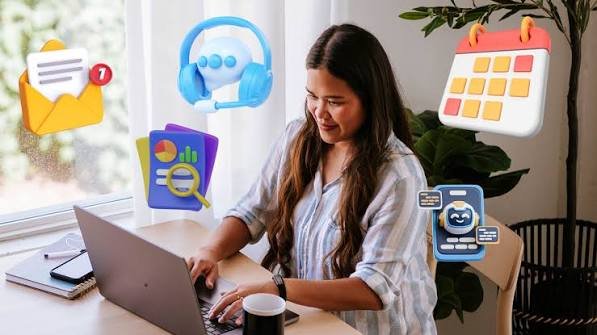
If you are an organised person and feel comfortable with a computer, virtual assistance may be one of the simplest options for you. A virtual assistant can work for a business owner, executive or team from a distance, assisting with daily activities.
You may need to:
Manage emails
Schedule meetings
Organise files
Conduct online research
Update spreadsheets
Manage calendars
Prepare simple reports
Handle administrative tasks etc.
It isn't always necessary to have several years of experience to get started. There are jobs that are entry-level that may be specifically seeking someone who is new to the career with minimal computer related skills, communication, attention to detail and ability to follow instructions.
Skills that can be learned to position yourself better include; Google Workspace, Microsoft Office, how to manage email, how to manage calendar, how to communicate and basic project management.
2. Customer Support Representative

Customer support may be a place to begin if you can communicate well with individuals and have the ability to resolve issues. Most of the time, the remote customer support representatives communicate with the customers by means of: Email, Live chat, Phone, Social media or Help desk platforms.
They answer questions, resolve complaints, process requests, or guide customers through company's products and services.
Past experience with remoting is not always required. The most important thing is to be able to communicate clearly, to be professional and solve problems. It's best suited for individuals who like to assist others and interact with people.
These are the skills that will be acquired: Customer service, written communication, CRM software and problem-solving.
3. Data Entry

Data entry is another job that can be considered, but pick the jobs wisely if you are a beginner. This usually requires inputting, updating and sorting data into a spreadsheet, database or other program.
You also might be required to verify information, organise digital records, udate customer information, transform information from one form to another, and carry out simple internet research. It's not just about being fast, it's about being accurate.
There are some entry level remote jobs that are explicitly offers data entry jobs for those who are new to the business, and only take basic computer operation, attention to detail, and follow instructions.
Skills acquired include; Microsoft Excel, Google sheets, basic research and file management skills, typing.
4. Social Media Management

If you know platforms like Instagram, TikTok, Facebook or LinkedIn, then you can leverage that expertise into a remote work opportunity.
A company could benefit from a social media manager to: Schedule posts, write captions, research content ideas, respond to comments, monitor messages, track basic analytics, and organise content calendars.
However, don't think that you are a social media professional if you spend hours on social media. You will need knowledge of content strategy, audience research, analytics and basic marketing.
The upside is that you don't need a paying client to build up your portfolio. Make pretend posts for fictional companies or volunteer to do social media for a small business.
The skills that will be developed are Canva, content planning, social media analytics, copywriting and scheduling tools.
5. Content Writing

For those who have good writing skills, content writing is a good remote job.
Companies require writers for:
Blog articles
Website pages
Product descriptions
Email newsletters
Social media content
Guides and educational material
The important thing is not simply being able to write grammatically correct sentences. You must be able to research activities, comprehend an audience, organize information and produce text that fulfils a purpose.
The skills to be learnt are storytelling, SEO, research, editing and content management systems.
6. Transcription

Transcription is the process of converting audio or video to text. For instance, a business could provide you with a video of the interview and request that you compose it into a written transcript.
You need: Good listening skills, accurate typing, good English skills, attention to detail, an internet and computer connection that is reliable and connected.
7. Online Tutoring

Another possibility is online tutoring, if you are especially proficient in a subject. You could teach: English, Mathematics, Science, Languages, Exam preparation, Professional skills etc.
You aren't required to teach full-time. Depending on the platform and content, you can teach online students on a flexible schedule. The key to this is that you already know the material. You don't have to learn an entirely new profession, you can package up what you already know and create a service.
In conclusion, don't choose a remote job simply because someone said social media is easy money. You don't have to pick the perfect career immediately. Your first remote job can simply be your entry point once you gain experience you can specialize and move into better paying roles. Getting your first remote job in 2026 doesn't necessarily require years of experience.
The above mentioned skills can give beginners different ways to enter remote work. Start with one. Learn it properly. Build evidence that you can do with. Then apply for roles that match your skills. It is important to note; your first remote job doesn't have to be your dream job it can be the experience that helps you qualify for the next one.